Numblock Factory Block Puzzle
- 4.8
- Rating
- 10.00K
- Installs
- Free
- Price
 Analysis by App-foxy
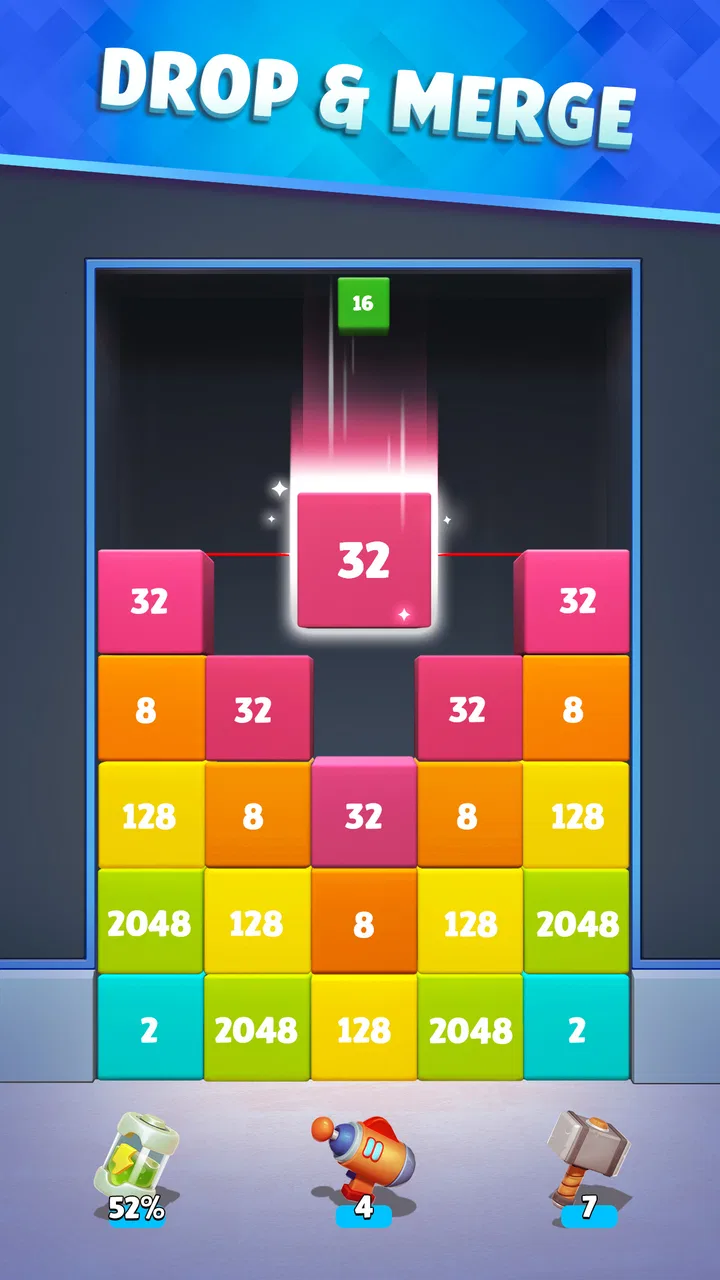
I spent time with Numblock Factory Block Puzzle as a compact 3D board game built around a very simple idea: combine numbered blocks, make larger values, and keep the board under control. That sounds familiar at first, but the three-dimensional presentation changes how I think about every move. I am not only looking for a matching number; I am also judging space, visibility, and whether a useful merge now will leave me with a difficult arrangement later.
That makes it a good candidate for short sessions when I want something more thoughtful than a completely passive time-killer. It is free to start, rated for Everyone, and comes from Voxel Cube Games. The game has attracted a 4.8 average from around 150 ratings and has passed 10K installs, which suggests that its straightforward concept has found an audience without needing a complicated premise.
My recommendation depends less on whether you enjoy number puzzles in general and more on what you want from one. If you like planning several moves ahead and enjoy watching a messy board gradually become manageable, this is worth trying. If you mainly want a traditional flat tile puzzle, a competitive board game, or a story-driven experience, the visual format and focused design may not be enough to hold your attention.
You May Also Like

 Blood Strike: 2.5 Anniversary
Blood Strike’s Loadouts Turn Every Drop Into a Tactical Gamble
A close look at Blood Strike’s custom loadouts: how fast access to signature weapons reshapes its battle royale rhythm, rewards preparation, and narrows the gap between fights.

 Pandora - Music & Podcasts
Pandora’s Music Is Easy to Start, but Harder to Recover
Pandora’s strength is its low-effort path from a seed to a station. Its weak spot is how much confidence it asks you to place in connection, setup, and quiet recovery.

 8 Ball Pool
 Is Built on Rivalries, Rematches, and Routine
A close look at the rivalries, rematches, shared routines, and unanswered safety questions that turn a quick pool match into a persistent mobile community.

 Samsung Music
’s Quiet Strength Is Playing What You Already Own
Its reach comes less from spectacle than from dependable access to a personal library. That simplicity is both the app’s strongest retention engine and its ceiling.

 AccuWeather: Weather Radar
AccuWeather Review: A Quick, Clear Forecast for Everyday Decisions
For everyday plans, the best forecast is the one you can understand quickly. AccuWeather makes rain timing, radar, and local conditions easy to act on, with a few trade-offs.

 Hill Climb Racing
Why Hill Climb Racing Still Turns Crashes Into One More Run
A tiny car, a bumpy hill and one more upgrade: Hill Climb Racing keeps resurfacing because its simple chaos makes every near-miss feel personal.
More From Our News Desk
View All News


What to consider before choosing it
Before choosing it, I’d think about whether reading a three-dimensional board sounds like an enjoyable part of the puzzle or an extra step you’d rather avoid. I’d also consider how comfortable I am with optional purchases in a free game, especially if a child will be using the device. Those practical preferences shape whether the game’s focused style feels inviting, which leads to how it compares with other board-game choices.
The real appeal is spatial decision-making
The important question in a round is not simply, “Can I merge these blocks?” I found myself asking whether the resulting larger block would improve the board or merely move the problem somewhere else. A merge can free room, but it can also occupy a valuable position and make future combinations harder to see. That tension gives the game more depth than its short store summary suggests.
The 3D layout is especially relevant for players who normally find flat number puzzles too predictable. Blocks have a physical presence, so the board feels more like a small arrangement that needs organizing than a spreadsheet of values. I had to pause occasionally to read the structure instead of reacting instantly to the most obvious pair.
For me, the best decision criterion is whether that extra spatial layer feels interesting rather than inconvenient. Some players will enjoy the need to inspect the board from its presentation. Others may prefer the immediate clarity of a classic two-dimensional grid, where every open space is visible at a glance. Numblock Factory sits closer to the former experience.
Session length and attention matter
This is the kind of game I would open while waiting for an appointment, taking a short break, or winding down before bed. Its core action is easy to understand, so I did not need a long tutorial or a large mental commitment before starting. At the same time, the decisions are meaningful enough that I could not always play on autopilot.
That balance is useful, but it also creates a limitation. If you are looking for a board game with social interaction, a campaign, or a strong sense of progression between sessions, this is probably too narrow. Its appeal is concentrated in the puzzle itself. I would choose it for a few focused minutes, not as my main game for an entire evening.
How much friction can you tolerate?
Any spatial puzzle lives or dies by how easily the player can understand the board. When the arrangement is clear, the number-merging idea feels satisfying. When several blocks compete for attention, the same perspective can slow down decision-making. I recommend playing with a deliberate rhythm rather than tapping rapidly; the extra second spent checking the whole arrangement can prevent a move that looks good locally but damages the next sequence.
A useful personal rule is to protect flexibility. I try not to merge merely because a pair is available. I first look for moves that either open a useful area or create a larger block that can participate in another planned merge. This approach makes the game feel less like chasing immediate points and more like managing a small, changing workspace.
What the purchase model means in practice
The game is free, which lowers the barrier to testing it for yourself. Optional in-app purchases range from $0.99 to $94.99 per item, so I would advise checking the purchase prompts carefully and deciding in advance whether you want to spend anything. The free entry is a strength, but the broad range means the experience may suit players who are comfortable ignoring optional spending more than those who want a completely purchase-free environment.
For a child, the Everyone rating makes the theme approachable, but I would still let a parent handle purchase settings. The number puzzle itself is easy to understand, while the financial side is a separate consideration. That is a practical distinction worth making before handing the device to a younger player.
Device compatibility and current build
Numblock Factory runs on Android versions starting with 7.0, so it is not limited to recent phones. The current version is 1.0.11, and the game was released on August 6, 2024. Those details matter if you are using an older Android device or deciding whether this is a lightweight option for a spare phone.
I would still judge it by how comfortable the board feels on your particular screen. A smaller display can make a three-dimensional arrangement less immediately readable, especially when several blocks are close together. That is not a reason to reject the game, but it is a reason to give it a proper trial rather than assuming the format will feel identical on every device.
Where this game wins, and where another type may fit better
I see its main advantage in giving solo number puzzling a spatial twist, but that strength is also a boundary: it won’t provide the shared decisions of a multiplayer board game or the clear grid of a conventional tile puzzle. I’d choose it when I want a compact challenge I can think through on my own, and look elsewhere when conversation, competition, or a different kind of progression matters more.
Its strongest advantage is the combination of simplicity and spatial planning
Many number puzzles are satisfying because they turn repetition into growth: small values become larger ones, and a nearly full board can suddenly open up. This game keeps that recognizable pleasure while presenting the pieces as blocks in a 3D setting. I liked that the visual treatment is not just decoration; it influences how I scan for opportunities and how carefully I place each move.
The game also works well for players who enjoy self-imposed improvement. Even without adding a story or a large rule set, I can focus on making cleaner decisions: preserve open areas, avoid cluttering the most useful spaces, and wait for a merge that improves the overall structure. That gives a thoughtful player something to refine over repeated sessions.
The best reason to choose it is the way a familiar number puzzle becomes a small spatial management challenge. It is approachable enough for casual play, yet it rewards restraint. I found that the most satisfying moments were not always the biggest merges; they were the turns where I kept the board flexible and created more than one future option.
A practical scenario where it fits naturally
Imagine having seven minutes before a train arrives. You want a game that starts immediately, does not require remembering a plot, and gives you a reason to stay engaged without demanding a full uninterrupted hour. This is a good match. I can begin with a clear objective, make a few careful moves, and stop when the journey starts without feeling that I have abandoned a larger narrative.
It also suits a short mental reset after repetitive work. Instead of scrolling through unrelated content, I can concentrate on one small problem: which block should move next, and what will that do to the available space? That kind of narrow focus is useful when I want stimulation but not a complicated task.
When a classic flat puzzle is the better choice
If your priority is instant visual readability, a conventional flat number-grid game may serve you better. Those games usually make rows, columns, and empty spaces easier to compare in one glance. Numblock Factory asks me to interpret a more dimensional arrangement, so it can feel slower when I want quick, almost reflexive play.
A flat alternative may also be preferable for players who already have a favorite strategy based on predictable lines and corners. Here, the block presentation changes the feel of that strategy. The underlying satisfaction of combining values remains, but the board does not invite exactly the same habits. I would choose this game when I want a fresh visual angle, not when I want the most familiar version of the formula.
When a competitive board game is a better choice
Although this belongs to the board-game family, it is not the right substitute for a game night. I would not install it expecting direct competition, negotiation, bluffing, or the social tension of taking turns with friends. Its challenge is personal and puzzle-focused. That makes it convenient for solo play, but it also means it cannot replace a multiplayer board game when interaction is the main reason you are playing.
The same distinction applies to players who need a strong progression system. A campaign-based puzzle game may offer chapters, characters, or a more explicit sense of destination. Numblock Factory is more about the quality of the current board and the decisions inside it. If you need a reason to return beyond improving your own play, another category may keep you interested longer.
Three habits that improve the experience
Before making an obvious merge, scan for the move that preserves the most open space. A slightly smaller immediate gain can be more valuable if it keeps future combinations visible.
Do not judge a block only by its current value. Its position can matter just as much. A larger block placed where it restricts several useful routes may be less helpful than a modest merge that keeps the board organized.
Use pauses as part of the strategy rather than treating them as hesitation. In a 3D arrangement, a quick visual check can reveal that two possibilities are competing for the same area. Planning one move ahead is helpful; checking the consequence of that move is better.
These habits are not complicated, but they change the game from random tapping into deliberate board reading. They also explain why I think it has more staying power than a basic merge toy. The challenge comes from controlling the consequences of a move, not merely recognizing a matching pair.
The compromises I noticed
The focused design can feel repetitive if you need constant novelty. Number merging remains the central activity, so players who quickly tire of repeating a familiar loop may reach that point sooner than players who enjoy polishing a strategy. I would not describe this as a flaw in the concept, but it is an important limit when deciding whether to make it a regular game.
The 3D presentation is another trade-off. It gives the puzzle its identity, yet it can also make the board require more visual attention than a flat alternative. If you play while distracted, the extra perspective may work against you. I had a better experience when I treated each session as a small concentration exercise instead of background entertainment.
Finally, the free-to-start model requires some purchase awareness. Players who prefer games with no optional spending at all may feel more comfortable elsewhere. Those who are happy to play without buying anything can try it at no initial cost, but I would still avoid tapping through prompts automatically.
What switching to it is really like
If you are coming from a traditional number puzzle, the cost of switching is low at the rule level. You already understand the pleasure of combining values and protecting room for later moves. The adjustment is visual: you need to read the blocks as a spatial arrangement and accept that the best move may not be the most obvious pair on screen.
If you are coming from a social board game, the switch is larger. You will gain convenience and solo focus but lose conversation, shared decisions, and the unpredictability of other players. If you are coming from a story-heavy mobile game, you will also be trading narrative rewards for a tighter loop built around immediate problem-solving.
That is why I would not call this a universal replacement. It is a targeted choice for someone who wants a compact, number-based board puzzle with a 3D identity. The game earns its place when that exact combination sounds appealing.
My recommendation for different players
I recommend giving Numblock Factory a try if you enjoy merge puzzles, like improving through better planning, and want something that works in short solo sessions. It is especially suitable for players who find ordinary number grids a little too familiar and would welcome a more physical-looking board without learning a large rulebook.
I would be more cautious if you need multiplayer interaction, a story, extensive content variety, or a completely frictionless flat layout. In those cases, a different board-puzzle category is likely to fit your expectations better. The game is not trying to be all of those things, and judging it by those standards would miss its main strength.
For me, the final decision is straightforward: install it if the idea of arranging and merging blocks in three dimensions sounds more appealing than simply filling a grid. Start with the free experience, play slowly enough to understand how the board behaves, and decide whether the spatial layer adds enjoyment rather than confusion. It is a focused recommendation, not a blanket one: choose it for thoughtful solo number play, and skip it when social competition or deep progression matters more.
Voxel Cube Games has kept the concept accessible, while the 4.8 average from around 150 ratings gives the game a promising reception among the people who have tried it. My own view is that its value comes from the small decisions between merges. It does not need a complicated premise to be engaging; it needs you to look at the board, resist the tempting move, and leave yourself a better problem to solve next.
FAQs for Numblock Factory Block Puzzle
01What is Numblock Factory Block Puzzle?
Numblock Factory Block Puzzle is a number-based puzzle game that combines falling or arranging blocks with simple arithmetic and strategic planning. Players place numbered pieces on the board, create matching or calculated combinations, and try to keep the factory-style grid from filling up. It is designed for short sessions, but increasingly difficult challenges can make each round surprisingly demanding.
02How do you play Numblock Factory Block Puzzle?
The main objective is to position incoming numbered blocks intelligently so that you can form valid combinations and clear space from the board. Before placing a piece, consider its number, shape, and the possible moves that may follow. Planning several turns ahead is important, because careless placement can block useful areas and leave no room for future blocks.
03Is Numblock Factory Block Puzzle free to download and play?
Numblock Factory Block Puzzle can generally be downloaded without an upfront purchase, allowing players to try the core gameplay at no cost. However, the experience may include advertisements, optional in-app purchases, or other monetization features depending on the platform and version. Check the store listing before downloading to confirm current pricing, ads, and purchase details.
04Does Numblock Factory Block Puzzle require an internet connection?
The basic puzzle experience may be playable offline, which makes it suitable for commuting, travel, or quick breaks without mobile data. Nevertheless, certain features—such as advertisements, cloud synchronization, leaderboards, events, analytics, or updates—may require an internet connection. Availability can differ between Android and iOS, so test the game offline after installation.
05Is Numblock Factory Block Puzzle suitable for children and casual players?
The game is generally approachable for casual players because its controls and core rules are easy to understand, while the number combinations provide additional mental challenge. It may be appropriate for older children, teenagers, and adults, but parents should review the age rating, advertising, and in-app purchase settings. Younger players may also need help understanding more advanced strategies.
Pros
- Simple controls make it easy to start playing immediately.
- Short rounds are ideal for quick breaks or casual sessions.
- Block placement offers satisfying visual and scoring feedback.
- The puzzle format works well for both beginners and experienced players.
- Offline play can make it useful when you have no internet access.
Cons
- Gameplay may become repetitive after extended sessions.
- Limited strategic variety can reduce long-term challenge for some players.
- Ads may interrupt the experience
- depending on the installed version.
- Small screens can make precise block placement less comfortable.
- Players seeking story or multiplayer features may find it too basic.

Numblock Factory Block Puzzle
Gallery